
Private AI for automation: the projects you had to turn down

Chances are your company has quietly ruled out automating the processes that matter most. Usually it wasn’t AI that drew that line. It was where the data was allowed to go.
“That would mean sending our clients’ data to some AI company’s servers. So, no.”
That’s how the conversation ends. No argument, no analysis – one sentence, and a good idea for automating real work is quietly dead. You’ve probably sat in that meeting. You may have been the one who said it.
It was the right call. With private AI for automation, it just doesn’t have to be the last word.
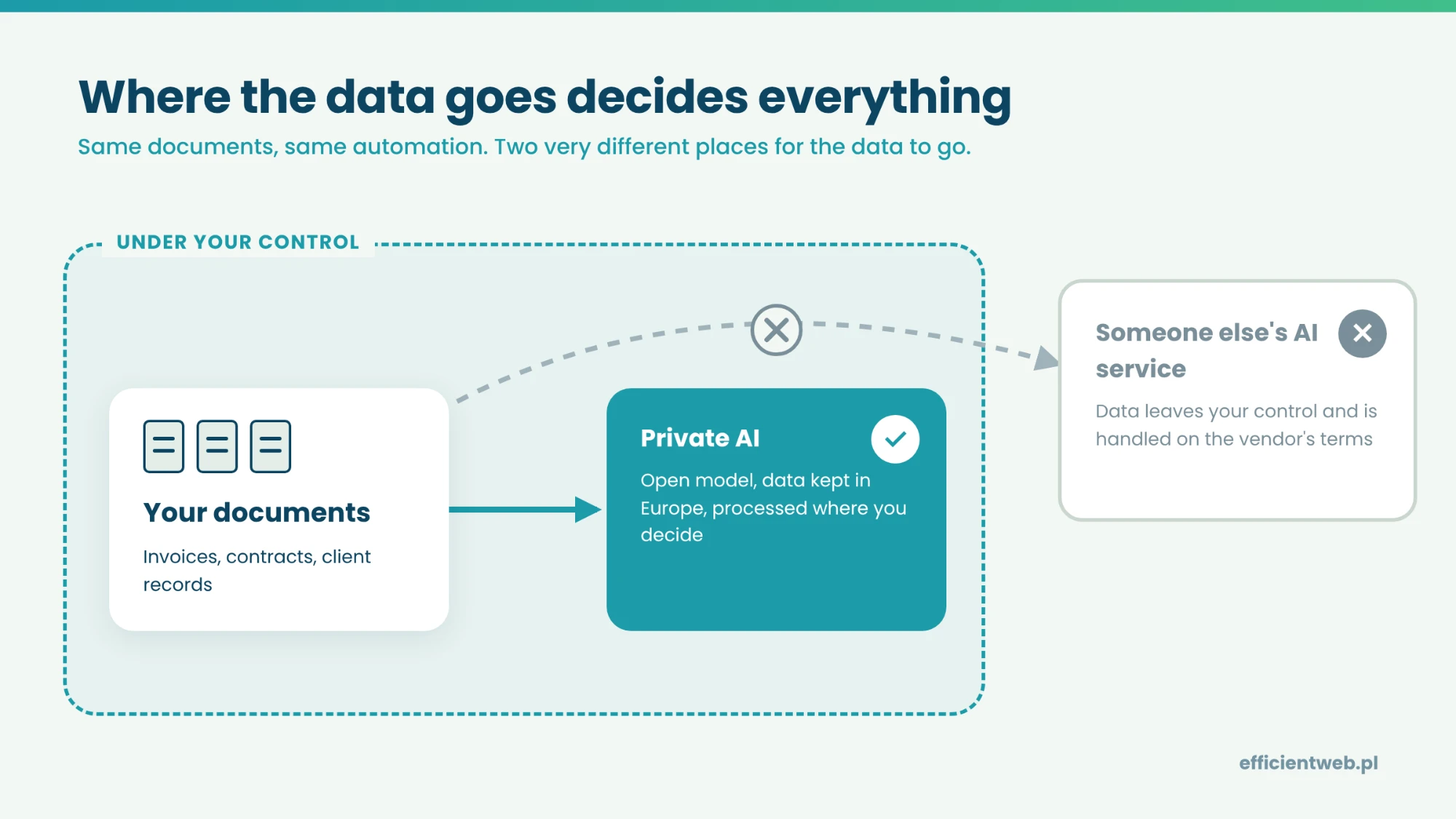
Where the data goes decides everything
It would be tidy if your company had a clear rule – AI for the harmless work, hands off anything sensitive. In practice it’s messier.
Someone pastes a contract into a public tool because it saves an hour, and nobody logs it. A promising use case gets half-banned, so it either dies or slips into the shadows where you can’t see it. People lean on AI for things they’re not sure they should, with a low hum of unease nobody says out loud. You don’t really know who is sending what, to whom.
All of it comes down to one fact, and it isn’t a fact about AI. The leaks, the quiet bans, the unease, the shadow use – none of it is about what the model can do. It’s about where the data goes, and the fact that with the tools most people reach for, it goes to someone else and is handled on their terms. So you end up managing a risk instead of using a tool.
And the work tangled up in all that caution is often the work that matters most – the contracts, the client records, the documents at the center of what you do. That’s the bind: the data you most need to protect is wrapped around the problems AI could help with most.
So the real question was never “do we allow AI, or not.” That question is what breeds the mess. The better one is narrower: can the work get done without the data leaving your control. Answer that, and most of the mess loses its reason to exist.
Private AI for automation doesn’t need a server room
When people hear “keep the AI in-house,” they picture a server room and a budget only a bank could love. That picture is out of date.
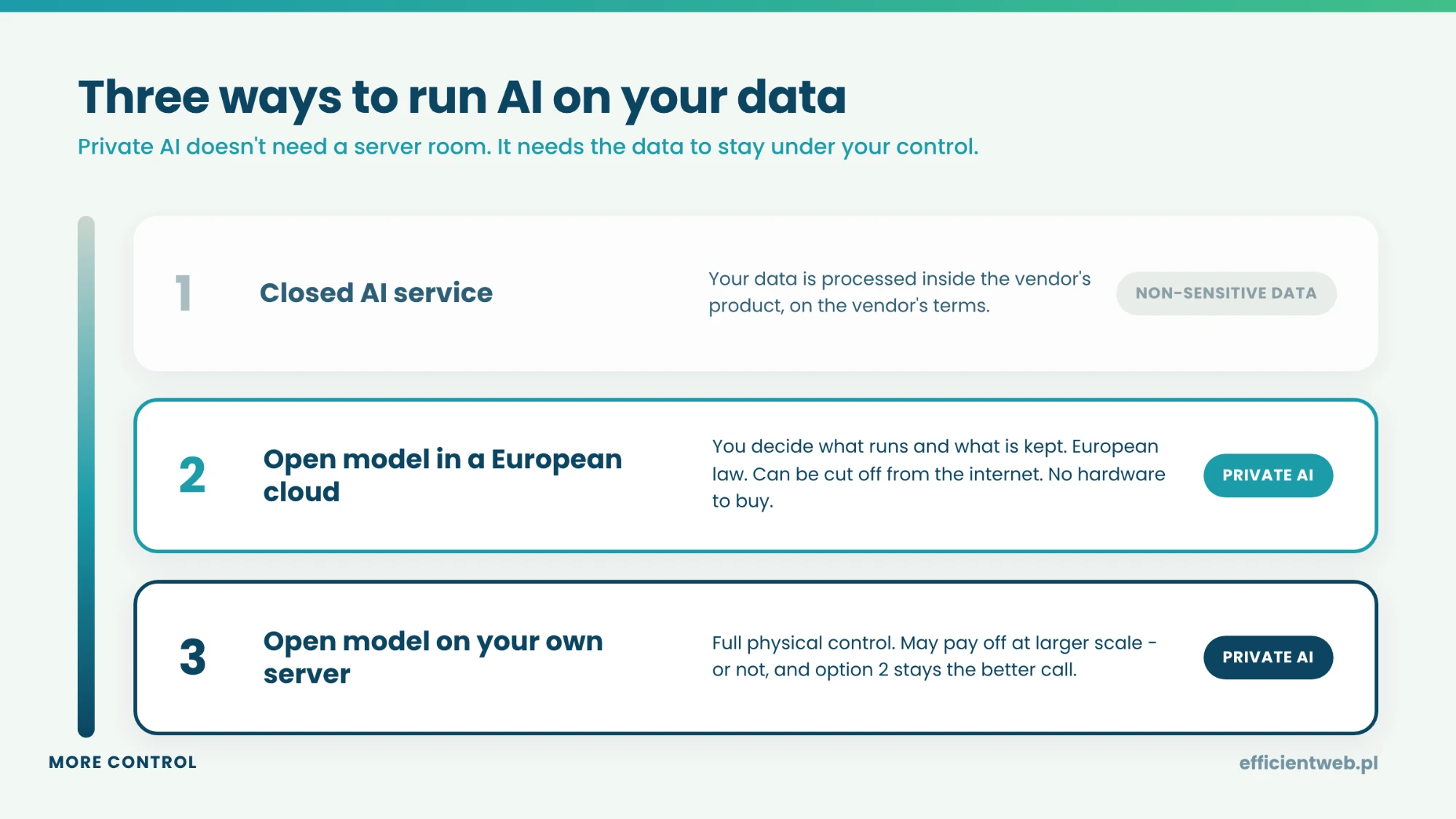
This is what it actually means, stripped of the mystique. An open model instead of someone else’s closed service, so the model itself is under your control. Your data staying where you decide – in Europe, or even inside your own country if the rules require it. And when the data demands it, a setup cut off from the internet entirely – which doesn’t have to mean a machine in your own building. None of this requires buying hardware. Delivered as a service, it can be up and running relatively quickly, and it lets you meet the regulations that apply to your data while keeping that data under your control.
A server of your own is an option, not a gate. Once you’re automating a lot of processes, it might pay off – or it might not, and staying on rented infrastructure remains the better call. If you don’t have a server room, or don’t want one, you may never need it.
One thing that trips up more companies than you’d expect: “our data stays in the EU” is not the same promise as “our data stays with us.” What matters is who runs the model and whose law the provider answers to. Send documents to a big AI vendor’s service and they’re processed inside its product, on its terms – and a vendor headquartered outside Europe can still be compelled under its home country’s law to hand them over, whichever region you picked. Rent infrastructure from a European provider and run an open model on it, and the picture changes: the provider supplies the machine, you decide what runs on it and what gets kept, and the data stays under European law.
From 4 hours to 10 minutes
When the data can stay under your control, the work that was off-limits opens up. The clearest example is work that’s drowning in documents.
We built this for a company in a regulated industry that handles sensitive documents on behalf of its own clients – the kind of work where a leak means fines and lost trust. Handing their clients’ data to an outside AI service was not an option. So the AI runs on an open model, in an environment under their control – their own hardware or a European cloud, whichever fits. It pulls the details out of invoices, statements, and transaction records, puts them into structured form inside their own system, and automates the steps that follow.
Work on those documents that used to take about 4 hours now takes about 10 minutes.
Strip out the specifics and the shape is familiar to a lot of businesses. Read the documents. Get the data into your system in a form you can use. Automate what happens next, the way your business actually works. The documents change from one industry to the next. The pattern doesn’t.
The possibility doesn’t build itself
Here I’ll be straight with you, because the opposite gets oversold. Putting a model next to your data does nothing on its own. Bolt a chatbot onto the side of a process, and you can watch nothing change and conclude AI was hype.
The value shows up when you automate the part that actually hurts. Sometimes that’s a whole process. Sometimes it’s a single step – the bottleneck everyone routes around, the manual task that quietly eats your best people’s afternoons. I’ve seen one key step, automated properly, make a huge difference to what a team gets done.
So the real question isn’t “where can we add AI.” It’s “where would automating one thing change how the work feels.” Answer that, keep the data where it has to stay, and the hard part of the decision is behind you.
Back to that meeting
The idea that got turned down might still be sitting there, waiting. The data still can’t go just anywhere – that part was never up for negotiation. What’s changed is that it no longer has to.
So it’s worth asking what your company has already ruled out, on the quiet assumption that AI and your most sensitive data could never be in the same room. The list may be longer than you think. And most of it was never really about AI.
This is the kind of work we do in Intelligent Automation Systems – automating the processes that matter, with your data kept where it has to stay. If something on your list has been waiting for the right moment, it’s worth a closer look.
Let’s Talk