
Benefits of Decoupled Architecture: What You Gain, What It Costs, and When It Pays Off

A product manager asks for one new field in the product catalogue. A filter attribute, nothing more. The change takes an afternoon. The release takes a week, because the catalogue, the checkout, the order export to the ERP and the B2B price lists all live in one application, and nobody wants to be the person who broke invoicing on a Friday.
That is usually when someone says “we need to decouple this.” They are often right. Just not always, and rarely in the way the first architecture diagram suggests.
This article covers the benefits of decoupled architecture, the costs that come with them, and how to tell which side wins in your system – with examples from e-commerce and from manufacturing and distribution, where an ERP, a PIM and a B2B portal have to work together.
Decoupled vs microservices: not the same decision
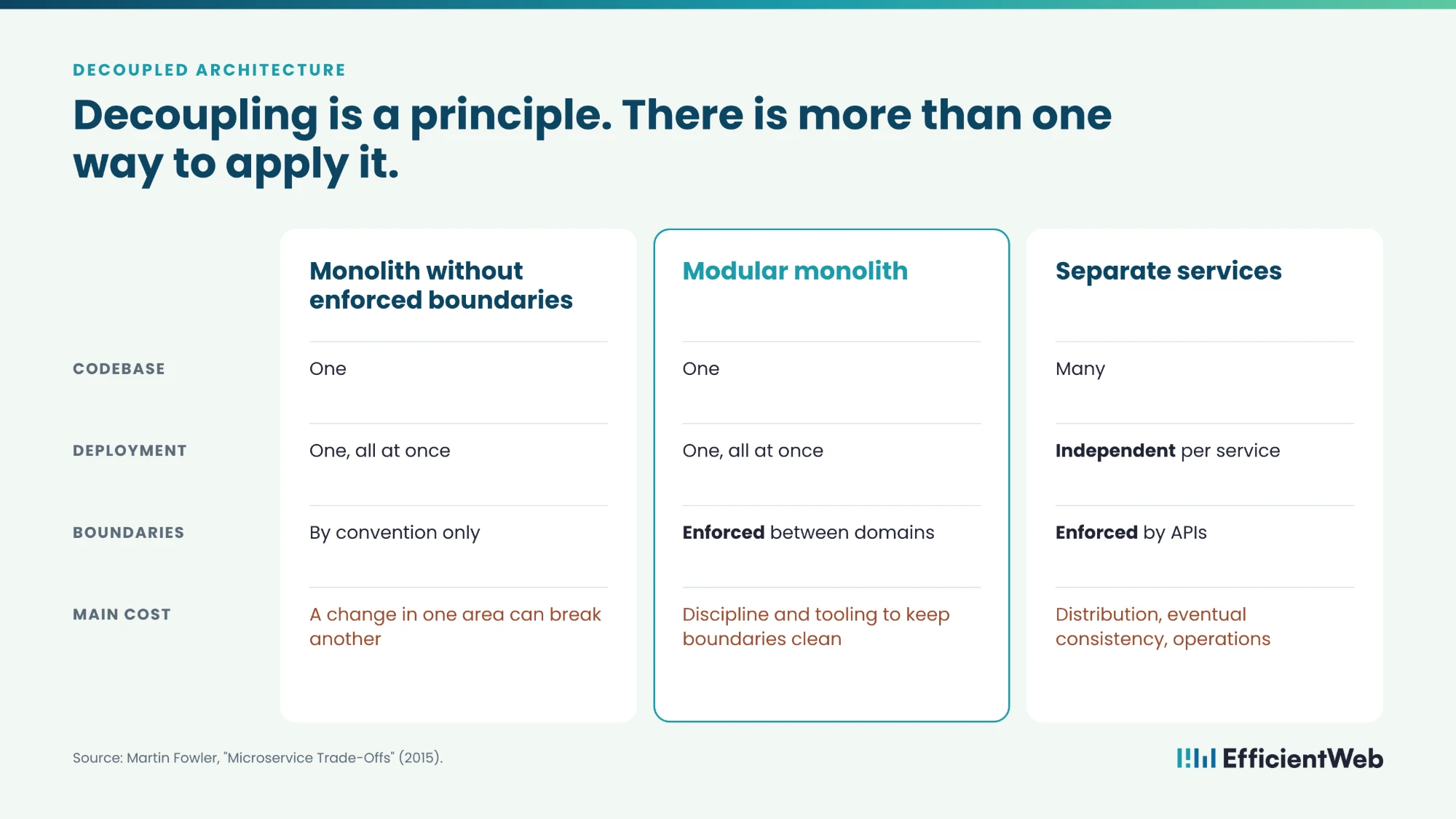
Decoupling is a principle. Parts of a system know as little about each other as possible and talk only through agreed interfaces. Microservices are one way to apply that principle: separate applications, separate deployments, a network between them.
There is another way. A modular monolith keeps one codebase and one deployment, but enforces strict boundaries between domains inside it. As Martin Fowler notes in his analysis of microservice trade-offs, strong module boundaries are possible inside a monolith too – they are just easier to erode there, because only discipline stops a shortcut across them.
So for most mid-sized systems the useful question is not “monolith or microservices”. It is “where are our real boundaries, and how hard do they need to be?” That question is the starting point for modular and decoupled architecture, and the answer decides everything below.
The real benefits of decoupled architecture
Martin Fowler names three benefits of splitting a system into independent services in his analysis of microservice trade-offs. They hold for decoupled architecture in general.
Boundaries that hold. Inside one codebase, a shortcut from the checkout straight into catalogue internals is one import away. Across a service boundary, the same shortcut requires an API change, so it does not happen by accident. This matters more as the team grows and fewer people see the whole system.
Independent deployment. A catalogue change ships without touching the checkout. A failure in one part is less likely to take down everything else.
The right technology per problem. Search can run on a search engine, ERP sync on a queue, the storefront on whatever renders it fastest – without rewriting the rest.
None of these comes free.
The costs nobody puts on the slide
Fowler lists three costs next to the benefits, and they are just as concrete.
Distribution. A function call becomes a network call. It is slower and it can fail. Someone has to decide what the checkout does when the pricing service does not answer.
Eventual consistency. An order in one system and stock in another will not agree at every single moment. You either design for that, or your customers find out for you.
Operational complexity. More deployments, more monitoring, more logs to correlate when something breaks at 2 a.m. This needs a mature operations practice, not good intentions.
Fowler calls the overhead the “microservice premium” and argues it only pays off in more complex systems. In other words, decoupling does not remove complexity. It moves it from the code into infrastructure and into the contracts between parts. That is a good trade when the parts are big and change at different speeds. It is a bad one when they are not.
Where it pays off: e-commerce and manufacturers
In e-commerce, the catalogue, the cart and checkout, payments and content change at different paces and carry different loads. A promotion hits the catalogue and checkout hard and leaves the back office alone. Separating those parts lets you release and scale them separately – which is exactly the pain from the opening scene.
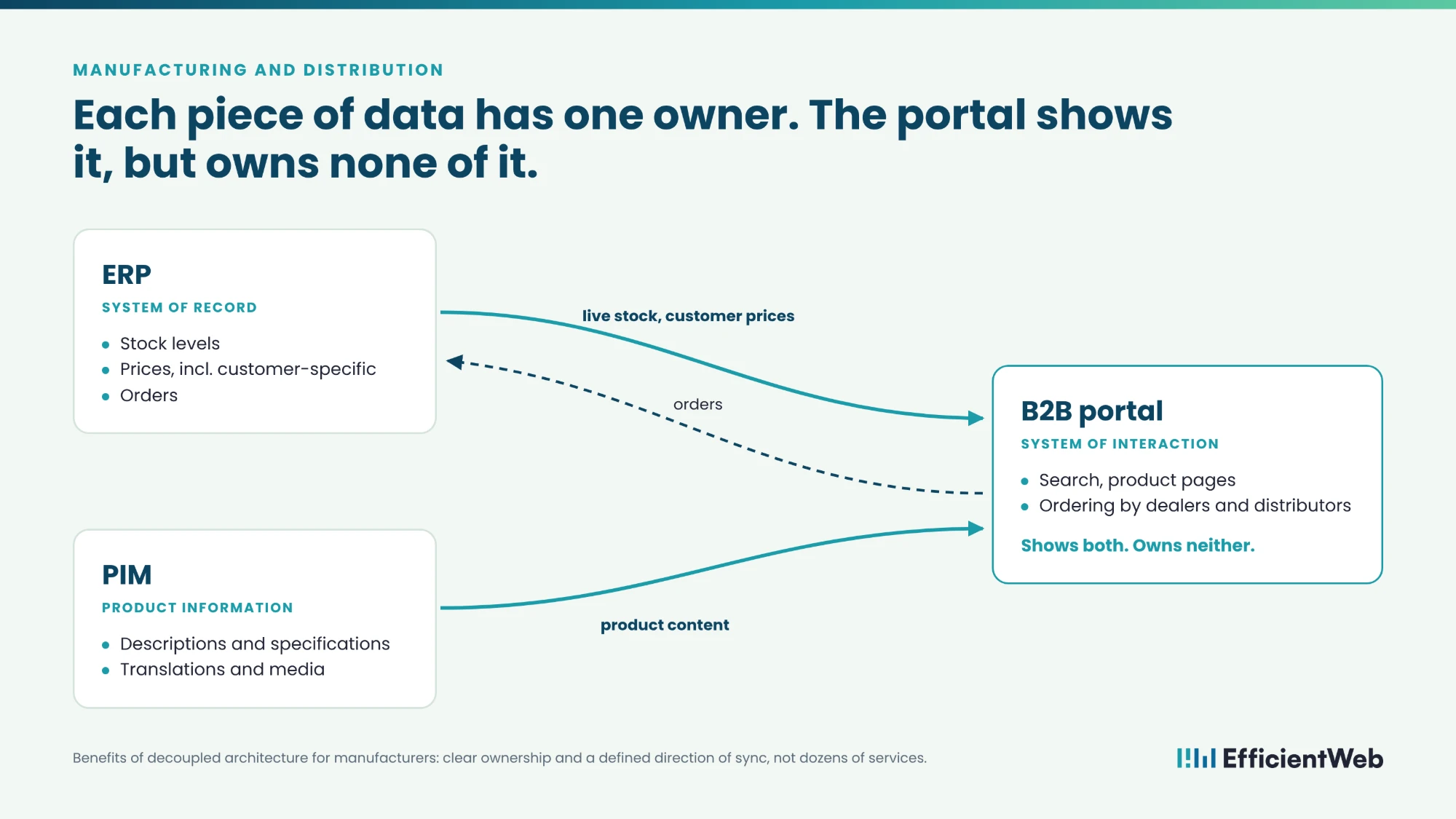
Manufacturing and distribution add a second dimension: several systems already exist, and each claims part of the truth. A common split looks like this:
- The ERP stays the system of record for stock, prices and orders.
- The PIM owns product information – descriptions, specifications, translations, media.
- The B2B portal is the system of interaction, where dealers and distributors search and order.
Trouble starts when the lines blur. The portal starts calculating prices on its own. The PIM quietly becomes a second source of stock levels. Two systems disagree, and support learns about it from a dealer.
That is where the benefits of decoupled architecture for manufacturers actually come from. Not from dozens of services, but from clear ownership of each piece of data and a defined direction of sync. Live stock and customer-specific prices come from the ERP. Product content comes from the PIM. The portal displays both and owns neither.
When not to decouple
If your team is small, your product covers one domain and your system is not complex, a monolith is cheaper and faster. Fowler’s Monolith First makes the case well: boundaries are hard to draw early, and fixing a wrong boundary between services costs far more than fixing it inside one codebase. Most of the successful microservice stories he describes started as a monolith that grew too big.
To be fair, Fowler himself notes the evidence on this is still thin. Our position is simpler: if you cannot name a boundary and explain why the parts on each side change at their own pace, do not put a network between them. Start with clean modules in one codebase. Split a module out when the boundary has proven itself.
How to decouple a legacy system without a big-bang rewrite
Replacing a working legacy system in one go is the most expensive way to find out what it actually did. The strangler fig pattern, as described in Microsoft’s architecture guidance, replaces it piece by piece while it keeps running.
- Put a façade in front. It intercepts requests and routes each one to the old system or to a new component. Users do not notice the difference.
- Pick thin slices with business value. Product search or B2B price lists are better first candidates than “the backend”.
- Add an anti-corruption layer. It translates between old and new, so the new component does not inherit legacy conventions just to talk to them.
- Move data in stages. The new component first works on the monolith’s tables. Then it gets its own database, kept in sync with the old one. Only after validation do the old tables go. Until that last step, rollback is cheap. After it, rollback means restoring objects and replaying data – so treat the removal as a deliberate final decision, not cleanup.
- Watch the façade. It must not become a single point of failure or a bottleneck.
This is the approach behind legacy e-commerce modernization: the business keeps selling while the system underneath changes.
The pattern has limits. It does not fit when you cannot intercept requests to the old system, when you have no access to its code or database, or when the system is small enough to replace whole.
Is it worth it for your system?
Four questions settle most cases:
- Can you name the boundaries, and do the parts on each side change at different speeds or under different loads?
- Does every key piece of data – price, stock, product content – have one owner, written down?
- Do you have the operational capacity for more moving parts?
- Can you start with one slice and stop if it does not pay off?
A clear yes to the first and the last means decouple, gradually. If the first one makes you hesitate, start with a modular monolith and let the boundaries prove themselves.
If you want a second pair of eyes on where those boundaries sit in your system, let’s talk about your architecture.